
Before the Parade Had to Die

Updated: Jun 1
One of my favorite pictures from childhood is me, age about five, standing on the corner of Larch Avenue and Main Street in Bogota, NJ - my hometown. I'm wearing a little red, white, and blue outfit, and I'm clutching the wooden stick attached to a kiddie American flag - the kind thousands of children have waved in similar spots for years.

"Never ever let the flag touch the ground," my mother whispered that sacred gentle admonition into my ear the same way she might have taught me a prayer. "We show respect to our soldiers. We wave the flag so they can see we are thankful when they pass by, we clap for them, and we don't let the flag touch the ground." When my own daughter was old enough to go to her first Memorial Day parade a couple of hours north near her own hometown, I heard myself uttering the same words. "Never let the flag touch the ground, kid."
By the time I said the words myself, many of the soldiers of my childhood were long gone of natural causes - having survived to become old men and women. Despite having lived through tremendous and terrible battles that didn't always end on the fronts of war, they had built lives and homes and careers. They carried something heavier than the rest of us. The widowers and widows of the fallen ever disappearing today, too. We owe their memory all.
The first year I told my daughter to hold her flag high, I realized with surprise that many of the soldiers passing by were now the age of my dad and my friends' fathers: Vietnam era. Yet, the tradition I had been taught hadn't changed for me.
For the first time in the 49 years of my life, the Memorial Day Parade in Bogota, NJ was permanently canceled this year. I grew up with some of the people who made the decision - and I fully appreciate and understand their logic. According to them, less than 100 people lined the route last year - a very low turnout, even for our little one-square-mile hometown. "Was it because of the weather the last few years?" I asked on Facebook - incredulous that such a thing could possibly occur. "No," came the answer. "No." The cost and services and work it took to create something with nearly no audience could no longer be justified.
When I heard that, I felt a pang of guilt for a lot of reasons. I - like so many who have moved away but not really moved on in our hearts - had found it harder and harder to "come home" for the parade for the last few years. Everything from other obligations, to invitations from friends up north where I now live, to weather, to a failed attempt to take an elderly friend to enjoy the Bogota parade a few years back that was foiled by poor health; there had been so many reasons I'd missed the parade, and while I was missing it, I had no idea that it was slowly dying.
The organizers suggested people in town get back to the true meaning of Memorial Day - honoring the soldiers who had given their lives for the rest of us across battles. They aren't wrong. After all, the day is really about ultimate sacrifice, respect for those left to mourn, and respect for a nation that - however flawed - has provided opportunity to so many for so long.
Aren't we supposed to live up to that somehow? Aren't we supposed to make the minor sacrifices of showing up, dragging lawn chairs, slathering on sunscreen, standing in drizzle simply to be present and attest to the fact that we still care? Of course we are.
And didn't anyone who'd marched in that parade remember the other types of memories? Clustered stumbling along out of step as Brownies or Boy Scouts? I'll never forget my arms shaking by the time the route was done after I'd carried the huge crash cymbals from the hilly top of town to the bottom in front of Steen School near River Rd. I'll always know how proud I was with every crash, how I got goosebumps when I played cadence on a snare drum, how special it felt to be a part of a small town society - warts and all. On days like the Memorial Day parade, we were all in it together.
Guests came: amazing marching bands, drum and bugle corps, soldiers, other towns' first responders. There was so much to see and hear. Generations mixing and mingling on the sidewalks. Dancing from the sidelines, balloons, flags, pretzels - you name it. And always, always, the somber remembrance in front of town hall at the soldiers' memorials - the stillness of it, the honor of it, had abided.
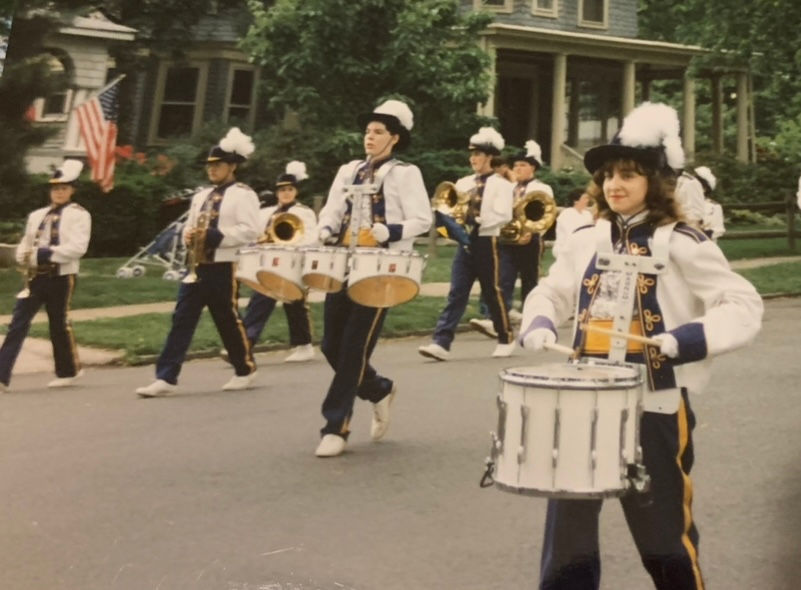
All of it - every single bit - meant something, meant a lot of things: hometown pride, national pride, belonging across socio-economic groups, religions, genders, and generations. In one little town, for a very long time, being together in music and marching mattered.
My hometown has changed markedly from the place it was when I was a child. Many have moved away or passed away. English is no longer the primary language spoken. Many new apartment buildings sometimes feel so big that they may just crush the little houses on the suburban streets. The schools have been reconfigured. Despite believing deeply and personally that the now diverse borough is exactly as it should be (and so much richer than it was during the mainly white-washed, eerily homogenous years of my youth), I will admit that I have wrestled at times with feeling otherly now in the place I grew up. I have worried in small moments about language barriers, and felt nostalgic for the people I knew and now miss - on the whole I have sometimes wondered if I still can belong when I come home.
But then, I have quickly reminded myself that the privilege I had always enjoyed as a white, Christian, American in a small town meant I had lived without feeling like an outsider forever - it's my turn now to adjust, my moment to experience a lack of belonging and own my discomfort, and that is a good thing. The present is my chance to be welcoming and hopeful and warm to the many wonderful hard-working people who now call Bogota home; it's my opportunity to learn, love and grow - to measure up to the ideals I claim are my own by fully living them out: that is a different kind of privilege, a better one.
More than that, it's my obligation and duty as an American to embrace all that America can be, that a hometown can be. It's my turn to believe that the Bogota of today can and should come together again as one.
So, I don't buy the excuse that nobody cares anymore because the town has "changed." In fact, I believe that many of the town's newest residents are some of the most patriotic Americans any of us will ever meet: people who truly appreciate what many of us have taken for granted because they know firsthand the sacrifice necessary to enjoy a small community.
We live in an era rife with division. We're all always fighting - across all manner of subjects. We're all invested in who is right and who is wrong. We spend time crushing opinions and people who may be different from ourselves. We're all always working, always busy, always...unwilling to pause. The instant gratification of technology has made any level of slowness and inconvenience seem less than worth much effort. But if we compare the small lift it takes to attend a parade to the sacrifices -- really hard sacrifices -- made by the generations that came before us, we should be ashamed of ourselves for not showing up.
This year, knowing there was no parade to rearrange my schedule for and attend felt awful. It felt like a death in the family, of a community, of reverence itself.
So, I'm going to hope and dream out loud. I'm going to hope that somehow in towns like my hometown where similar loss is likely happening, we'll work to do better. I'm going to wish and pray that if we start now, maybe we can bring the Memorial Day Parade back to Bogota, NJ, and communities like it. And I hope when we do, it will be in the spirit of belonging and togetherness I remember. No neighbor better than another, none too rich or too poor to share a sidewalk filled with lawn chairs while the rhythmic sounds of a beautifully-evolving America pulse on. We can invite new ways to ensure the parade is meaningful for all. For us long-timers who may have forgotten, we can commit to remember and show up,
And most of all, for those who have sacrificed all, we can line tree-filled streets once more while the bands march on. If we are, indeed, a grateful nation, let's show it in the ways that matter most.


Comments